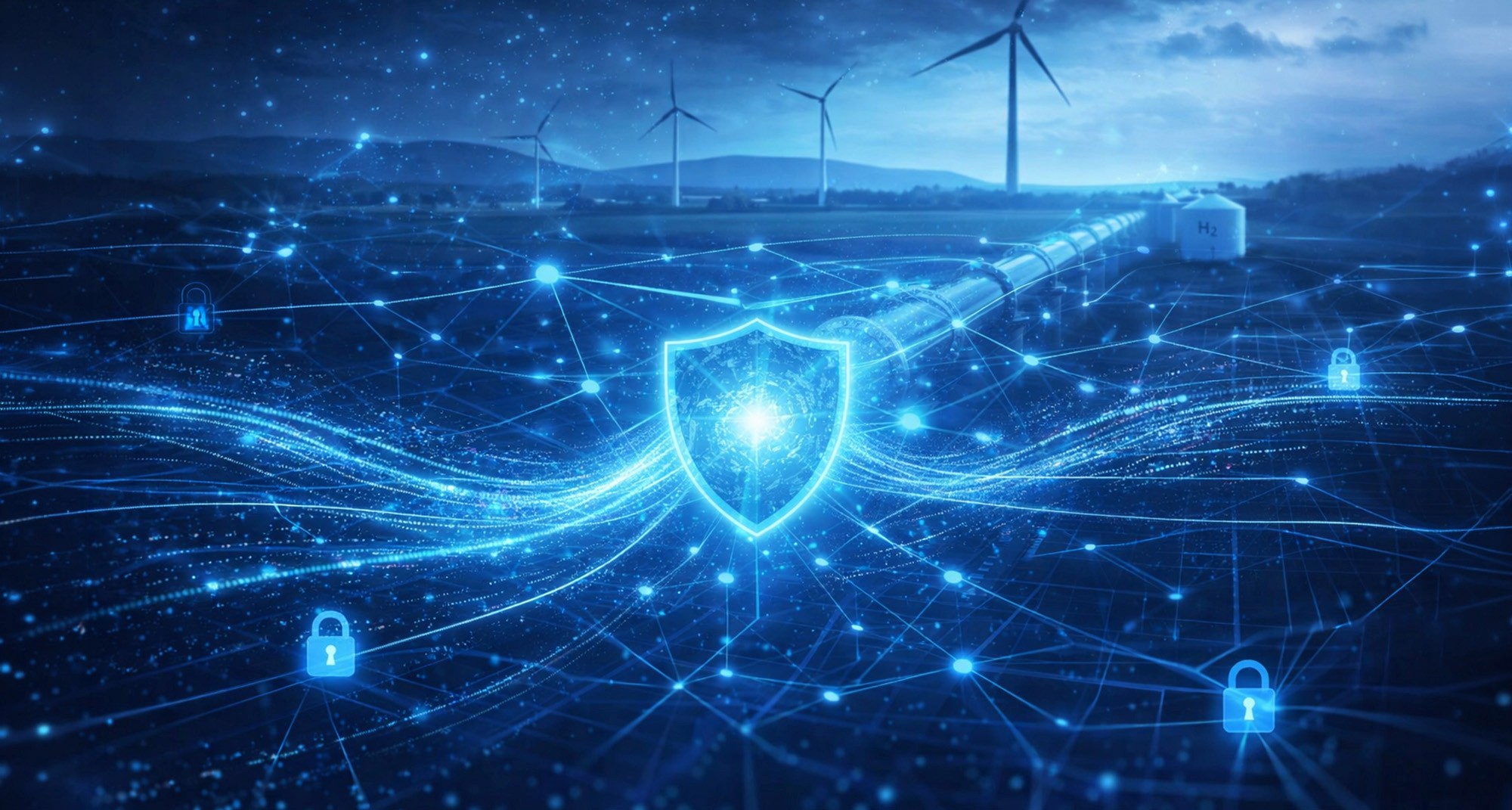
The development of large renewable hydrogen storage capacities will be a key element of the future energy system. As these infrastructures become strategic assets, ensuring their security and resilience will be a fundamental requirement.
GUARDIANE-Q is a Spanish industrial research project investigating new technological solutions to reinforce the protection of critical energy storage infrastructures; contributing to improving the resilience of the energy system, strengthening technological autonomy and consolidating sovereign capabilities against hybrid threats.

Strategic impact





How we work
GUARDIANE-Q is structured into five complementary technical-scientific lines that, together, configure an integral protection architecture for critical energy infrastructures.
The project is being developed over a four-year timeline (2026–2029) with progressive technical milestones oriented towards system integration, validation in controlled or representative environments, and the consolidation of technological results with potential for future transfer.
01
Comprehensive analysis of risks and vulnerabilities
Identification of physical, environmental, and digital threats to understand what can go wrong, why, and with what consequences, establishing an analytical basis for the design of protection solutions.
02
Advanced multi-sensory monitoring
Design and integration of smart sensors (optical, seismic, geochemical, among others) combined with multivariable analysis algorithms capable of detecting early warning signs of anomalies.
03
Distributed intelligence and automated response
Development of an edge–cloud architecture capable of integrating multiple sensory data flows, executing early warning algorithms, and supporting automated incident responses.
04
Resilient satellite communications
Research into secure connectivity solutions to guarantee data transmission even in scenarios of degradation or loss of terrestrial networks.
05
Post-quantum cybersecurity
Development of advanced cryptographic mechanisms and quantum entropy generation oriented towards protecting critical infrastructures against emerging cyber threats.
Consortium
GUARDIANE-Q is developed by an industrial consortium coordinated by Trinity Energy Storage, together with:




The project also has the scientific and technological support of a network of collaborating entities from the academic and research fields, including:
Frequently asked questions
What is GUARDIANE-Q?
GUARDIANE-Q is an industrial research project aimed at the design and validation of a comprehensive advanced security architecture for critical underground storage infrastructures of renewable hydrogen.
The project combines physical, environmental and digital risk analysis, smart monitoring, resilient communications and post-quantum cryptography, with the aim of reinforcing the resilience of these strategic infrastructures.
Why is it necessary to store renewable hydrogen on a large scale?
The energy transition requires managing large volumes of renewable energy that are not always consumed at the moment they are generated.
Renewable hydrogen makes it possible to store energy for long periods (seasonal storage) and decarbonise industrial sectors that are difficult to electrify. For this model to be viable, it is essential to have massive and secure storage capacities.
Why use depleted natural gas fields to store hydrogen?
Depleted reservoirs have demonstrated their capacity to store gas safely for decades.
· Reusing these infrastructures allows to:
· Take advantage of already characterised geological structures.
· Reduce the environmental impact compared to new infrastructures.
· Optimise investments through the use of existing facilities.
GUARDIANE-Q investigates how to reinforce the safety of this type of storage in the context of renewable hydrogen.
Is it safe to store hydrogen underground?
Underground gas storage is a well-established practice in the energy sector.
In the case of hydrogen, it is necessary to adapt monitoring systems, operational protocols and digital protection mechanisms to its specific characteristics.
GUARDIANE-Q researches and validates technologies that enable the underground storage of renewable hydrogen in depleted reservoirs to be carried out with the highest standards of physical, environmental and digital security.
What risks does the project analyse?
The project addresses a comprehensive approach to risks, including:
· Physical risks (leaks, structural integrity).
· Environmental risks.
· Operational risks.
· Cyber threats.
· Hybrid threat scenarios (physical-digital combination).
Based on this analysis, advanced early detection and intelligent response systems are designed.
Which technologies does GUARDIANE-Q develop?
The project integrates five major technological areas:
· Advanced risk modelling.
· Multisensory monitoring in a representative environment.
· Intelligent supervision and response platform.
· Sovereign and resilient satellite communications.
· Post-quantum cybersecurity applied to industrial environments.
These technologies are validated in controlled or representative environments, not in commercial operation.
What does it mean for the project to have a “dual” dimension?
The technologies developed in GUARDIANE-Q —such as resilient communications or post-quantum cryptography— can have applications in both civilian infrastructures and strategic security and defence environments.
The project is aligned with Mission 6 of the Science and Innovation Missions Programme, focused on strategic autonomy in security and defence.
How does the project contribute to Spain and Europe's energy goals?
The development of secure hydrogen storage is a key element for:
· Meeting the objectives of the NECP.
· Advancing the European Hydrogen Strategy.
· Strengthening energy autonomy driven by initiatives such as REPowerEU.
Without massive and resilient storage, the large-scale integration of renewables is not viable.
Does the project involve the immediate commercial exploitation of the storage?
No. GUARDIANE-Q is an industrial research project aimed at the design and conceptual and experimental validation of advanced security technologies.
It does not contemplate the industrial exploitation or commercial deployment of final solutions, but rather the generation of knowledge and strategic technological capabilities.
What is the relationship between GUARDIANE-Q and the EUH2STARS project?
EUH2STARS is a European project aimed at the technical validation of large-scale underground hydrogen storage.
GUARDIANE-Q complements this effort by incorporating a specific dimension of comprehensive safety, advanced cyber protection, and operational resilience.
Both projects contribute to the development of strategic capabilities in renewable hydrogen storage in Europe.
Contact us
If you need information about GUARDIANE-Q, you can write to us using the form. We will respond to you as soon as possible.